


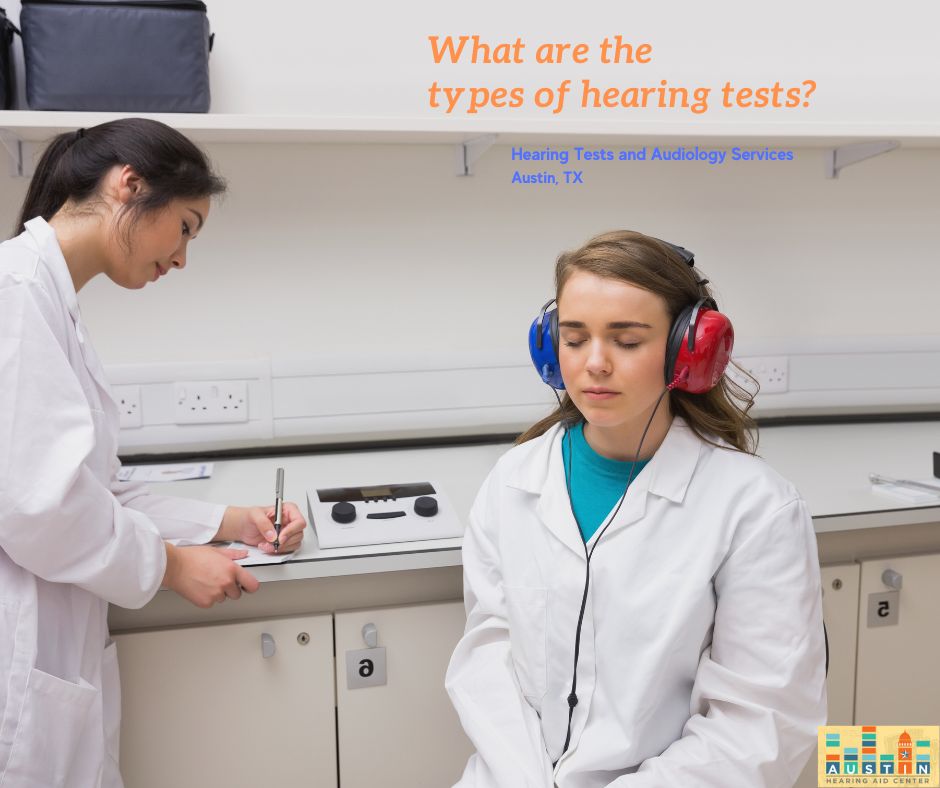
If you suspect that you, a family member, or a friend might need hearing aids to hear better, the first step is to get a hearing test.
Hearing tests serve as a baseline in determining the impact of hearing (or the lack of hearing) in your daily life, including social and professional settings.
Types of Hearing Tests
There are numerous types of hearing tests. Some are considered to be standalone tests while some can be combined with other hearing evaluations to get a clearer picture of one’s hearing capacity.
Below are some of the most common types of hearing tests:
1. Pure tone testing
This test assesses an individual’s ability to hear different pitches and volumes of sound through air conduction. The test is conducted by having the person wear headphones and sit in a special booth. The test consists of a series of sounds that are played through the headphones. The individual is instructed to indicate when they hear a sound by raising their hand or pressing a button. The results are then recorded and plotted on an audiogram.
2. Bone conduction testing
Another form of pure-tone test, known as bone conduction audiometry, evaluates an individual’s inner ear response to sound. This test is carried out by placing a conductor behind the ear, which sends small vibrations directly to the inner ear through the bone. This differs from the traditional method, which uses air to transmit audible sounds. If the results of this test differ from the traditional pure-tone audiometry, we can use this information to determine the specific type of hearing loss.
3. Speech testing
Speech testing for hearing loss, also known as speech audiometry, is a type of hearing test that measures an individual’s ability to understand and process spoken language. This test can help to determine the degree and type of hearing loss, as well as the individual’s ability to communicate in different environments and with different types of speech.
During the test, the individual will be asked to repeat words or sentences that are presented at different volumes and pitches. The results of the test are then plotted on an audiogram, which can be used to determine the individual’s speech reception threshold (SRT) and speech discrimination score (SDS).
In addition to determining the degree and type of hearing loss, speech testing can also be used to evaluate the effectiveness of hearing aids or other devices, and to monitor the progress of individuals with hearing loss over time.
4. Tympanometry
Tympanometry is a test that measures the movement of the eardrum in response to changes in air pressure. It is used to evaluate the health of the middle ear and to detect problems such as fluid in the middle ear, perforations in the eardrum, and problems with the ossicles (the tiny bones of the middle ear).
During the test, a small probe is placed into the ear canal, and air pressure is varied. The probe measures the movement of the eardrum in response to these changes in pressure. A graph called a tympanogram, is produced that shows the eardrum’s movement at different air pressures.
Hearing Tests in Austin, TX
Worried about your hearing? Ask an audiologist for a professional opinion.
Getting a hearing test is important because it can help to identify any hearing loss or other issues with the ears. Early detection and treatment of hearing problems can help prevent further damage and improve overall communication and quality of life.
There are various types of hearing tests, with unique approaches and attributes to identify not only hearing loss, but also underlying conditions, such as ear infections or tumors, that may be causing hearing loss. Audiologists are professionals who are trained and knowledgeable in conducting many types of hearing tests to come up with an accurate hearing evaluation.
Regular hearing tests can help to monitor any changes in hearing over time and ensure that any necessary adjustments are made to hearing aids or other devices.
Whatever your hearing concerns may be, addressing them usually starts with a hearing test.
Austin Hearing Aid Center has expert audiologists in Austin, TX, trained to perform different types of hearing tests to provide accurate diagnosis and hearing evaluations.
Schedule your hearing test with us today!